Do OGs or Bombshells win Love Island?
The dataset covers contestants from Love Island Australia, UK, and USA across multiple seasons. Each row is one contestant, with their entry day, exit day, and final placement. Contestants are labeled either OG (original islanders, present from day one) or Bombshell (latecomers who enter mid-season to shake things up).
The central question: does it actually matter when you walk through those villa doors?
Do OGs or Bombshells place higher?
As individuals
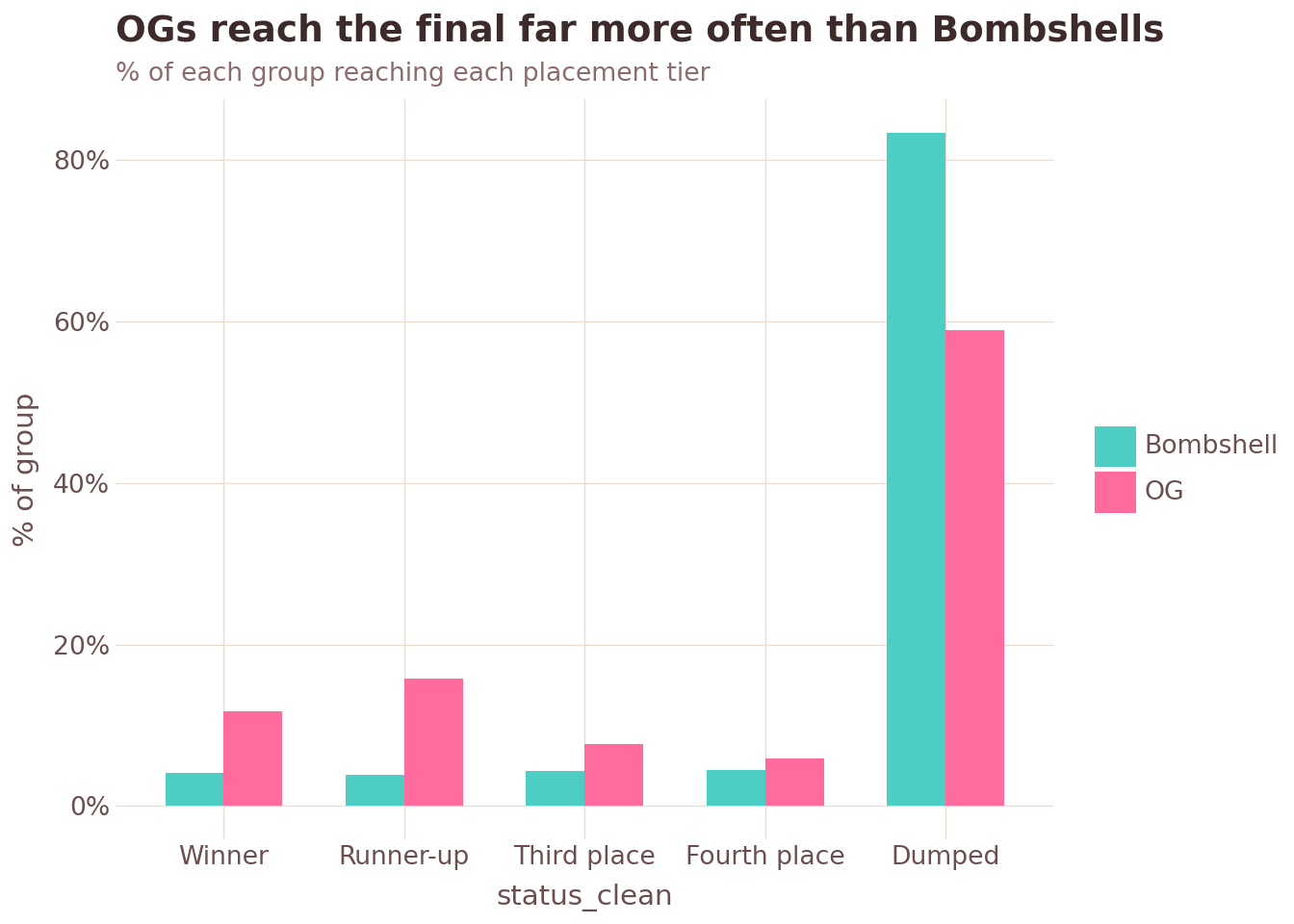
The most direct way to look at this is to ask: of all the OGs across every season, what share ended up winning? What share were runners-up? And how does that compare to bombshells?
The OG advantage is hard to miss. A much larger share of original islanders make it to the winner and runner-up spots compared to bombshells, while bombshells are dramatically over-represented among the dumped. This alone might just reflect that OGs have more time in the villa — but the gap at the very top is still striking even after accounting for that.
Who’s in the room?
Another way to frame this: look at the composition of each placement tier. If bombshells were equally competitive, you’d expect them to make up a meaningful share of winners — but do they?
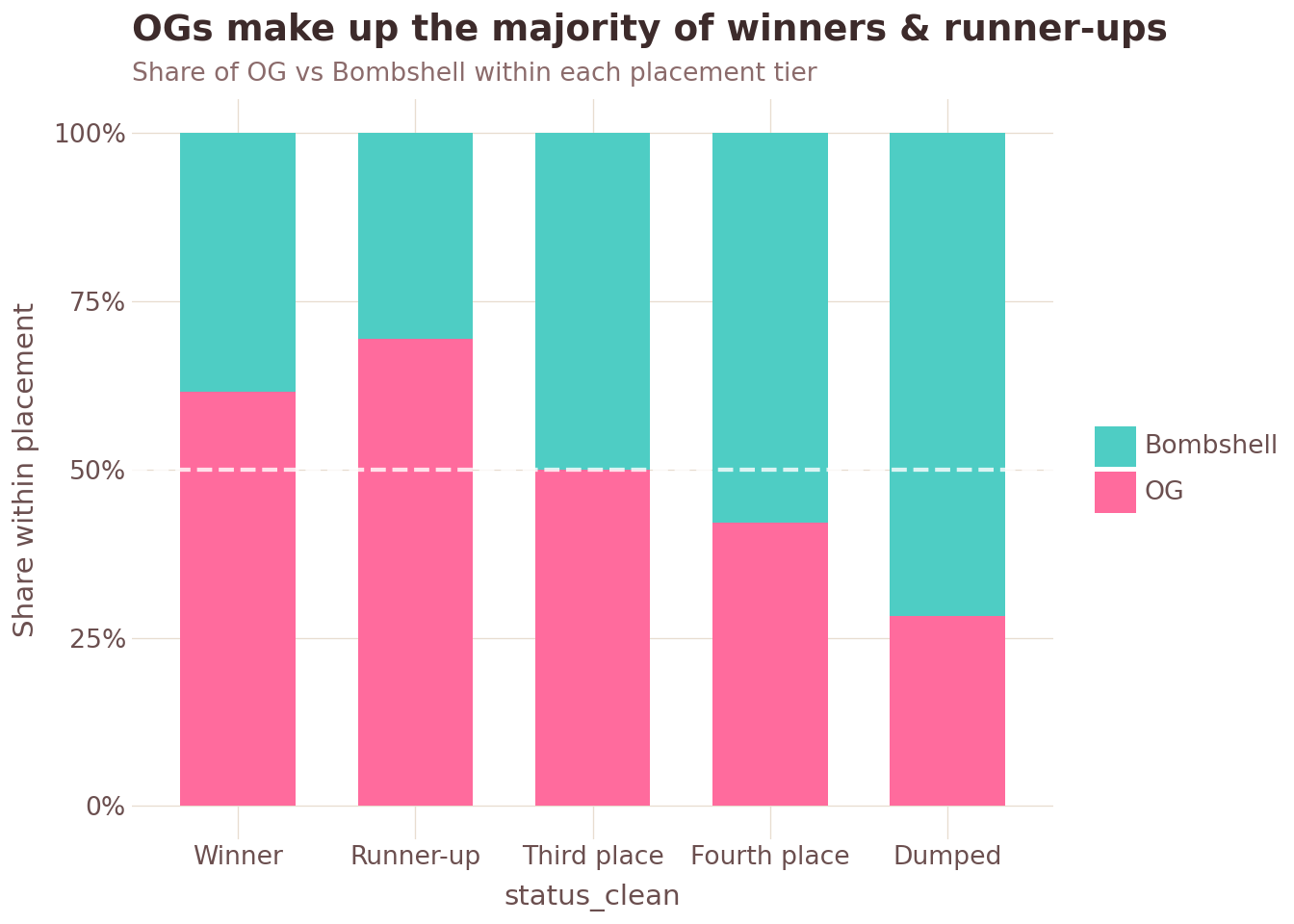
The dashed line marks a 50/50 split. For every placement tier except “Dumped,” OGs hold the majority — and that majority gets more pronounced the higher you go. Winners and runners-up are overwhelmingly OG. The “Dumped” category flips, with bombshells making up a greater share, which makes sense given that many bombshells enter and exit quickly without ever threatening the top spots.
Has the OG advantage changed over time?
Shows are always tinkering with their formats. Has the bombshell strategy gotten more effective over the years, or has the OG advantage held steady?
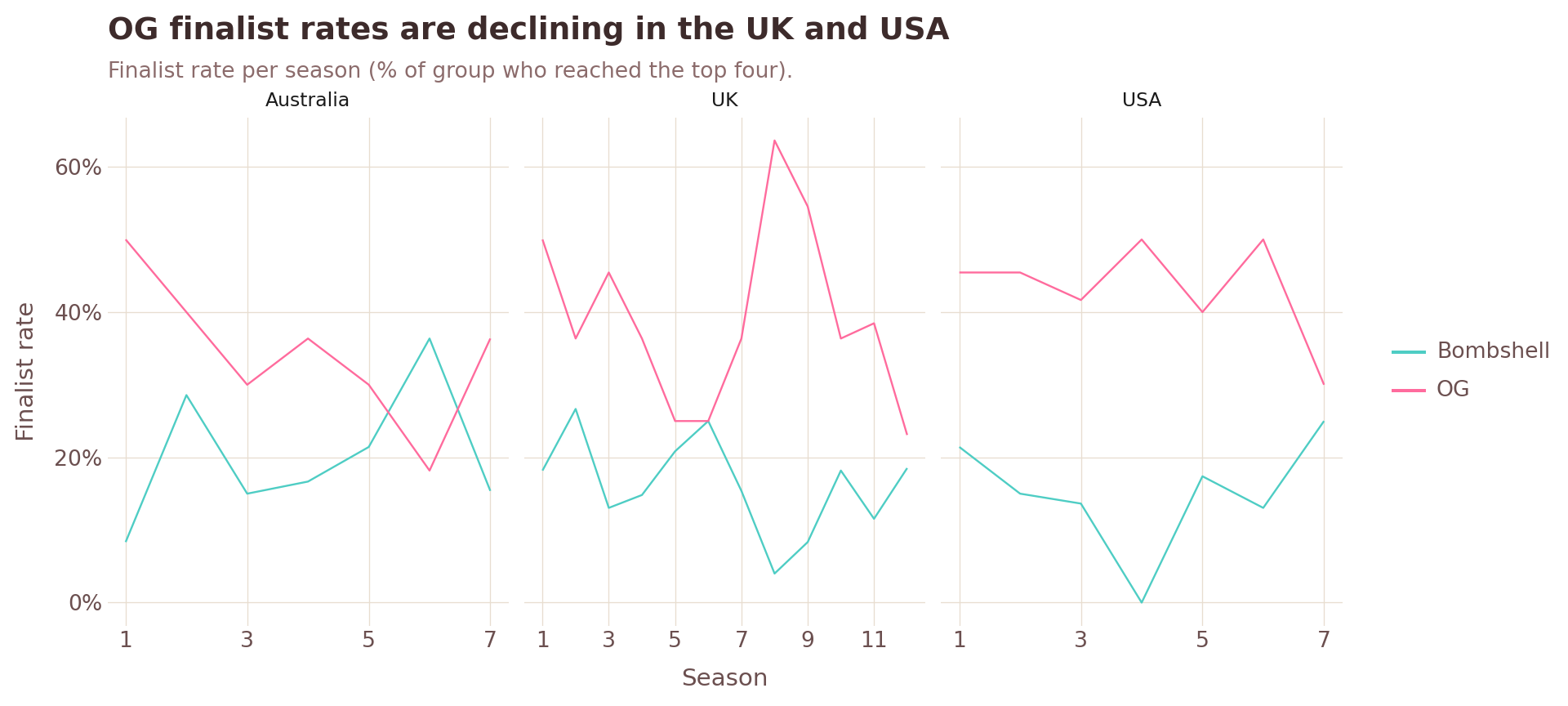
There’s a lot of season-to-season noise here, so don’t read too much into individual wiggles. The broader pattern for the UK and USA does suggest the OG advantage may be softening over time — more recent seasons show the lines converging. Australia, with fewer seasons in the data, is harder to read. Whether this reflects intentional format changes (more strategic bombshell casting?) or just natural variation is an open question.
What about couples?
Love Island is ultimately a couples competition. So far we’ve looked at individuals, but the real unit of competition is the pairing. Let’s classify each finalist couple as Both OG, Both Bombshell, or Mixed, and see which type tends to win.
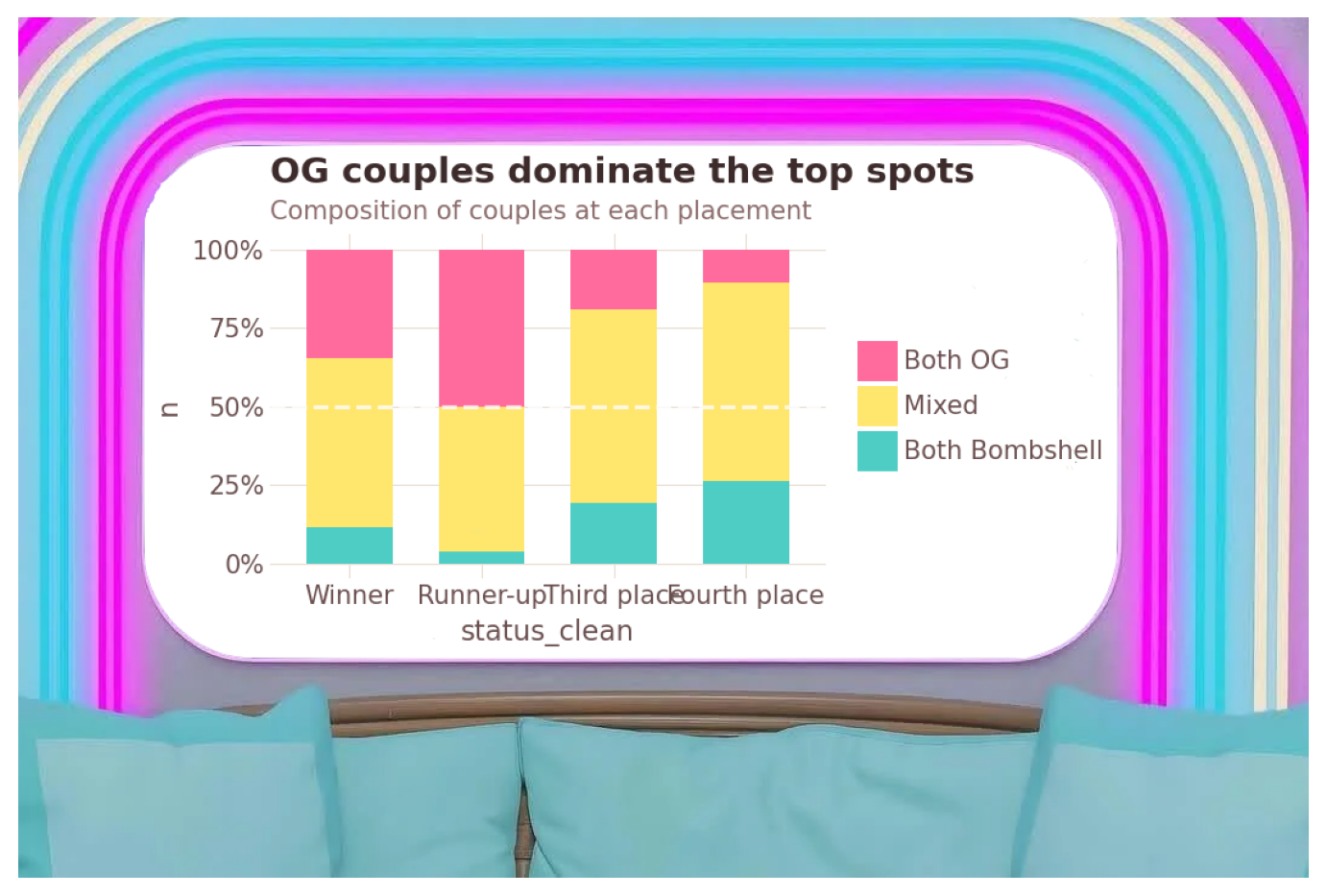
The couple-level view reinforces everything we saw with individuals. Both-OG couples make up a majority of winners and runners-up. Mixed couples (one OG, one bombshell) do appear in the finals, but both-bombshell couples at the very top are rare. If you walk into the villa on day one and find your person early, the data suggest that’s still the most reliable path to the final.